



Blog
The Ultimate Guide to Using Scaffold Towers on Uneven Ground & Stairs, UK
Working at height is inherently risky. But when you introduce uneven ground, sloping surfaces, or staircases, the level of risk increases significantly.
In the UK, perfectly level ground is often the exception rather than the rule. From sloped driveways and tiered gardens to narrow staircases in older properties, both tradespeople and DIY users frequently face challenging working conditions.
This guide explains how to safely use aluminium scaffold towers on uneven ground and stairs, while remaining compliant with UK regulations such as the Work at Height Regulations 2005 and BS EN standards.

Super DIY Tower on Uneven Ground
Why Uneven Ground & Stairs Increase Risk
Scaffold towers are designed to operate on firm, level surfaces. When that assumption is removed, several critical hazards arise.
1. Reduced Stability
Even a slight imbalance at the base can make a tower unstable. Once weight is added—workers, tools, or materials—the risk of tipping increases dramatically.
2. The “Lean Effect”
A small deviation at ground level becomes amplified at height. For example, a few millimetres out of level at the base can result in a noticeable and dangerous lean at increased working heights.
3. Uneven Load Distribution
If one leg carries more weight than others, it can overload specific components, leading to structural stress or failure.

4. Legal & Compliance Risks
Under the Work at Height Regulations 2005 (WAHR), all equipment must be stable and used appropriately. Failure to do so can result in fines, invalid insurance, or prosecution.
⚠️ Critical Safety Warning: Never use loose bricks, timber offcuts, or blocks to level a scaffold tower. This “quick fix” is one of the most common causes of tower collapse.
UK Regulations You Must Follow
When using scaffold towers on uneven ground or stairs, compliance is essential.
Work at Height Regulations 2005 (WAHR)
- ✓ Work must be properly planned and risk assessed
- ✓ Equipment must be suitable and stable
- ✓ Users must be competent
EN 1004-1:2020
- ✓ Applies to mobile access towers used commercially
- ✓ Defines safe assembly, stability, and use
HSE Guidance
- ✓ Towers should be used on level ground wherever possible
- ✓ If not, proper levelling equipment must be used
👉 Important distinction: DIY/home use towers do not always require certification, but trade and commercial users must use compliant systems.
Solutions for Using Scaffold Towers on Uneven Ground
There is no one-size-fits-all solution. The correct approach depends on the severity of the slope, the surface type, and the working height.
1. Height-Adjustable Wheels (Best for Minor Slopes)
Height-adjustable castors are ideal for slight gradients on solid surfaces.
When to use:
- 📍 Slightly sloped driveways or pavements
- 📍 Indoor floors with minor unevenness
- 📍 Jobs requiring frequent repositioning
How they work: Each wheel can be independently adjusted to level the base, then locked securely in place.
Key safety points:
- 🔒 Always lock both the height adjustment and the wheel brake
- 🔒 Mandatory: Re-verify levels at regular intervals and immediately after every repositioning
- 🔒 Ensure wheels are rated for the full load
🚫 Not suitable for: Grass or soil, or soft or unstable ground.
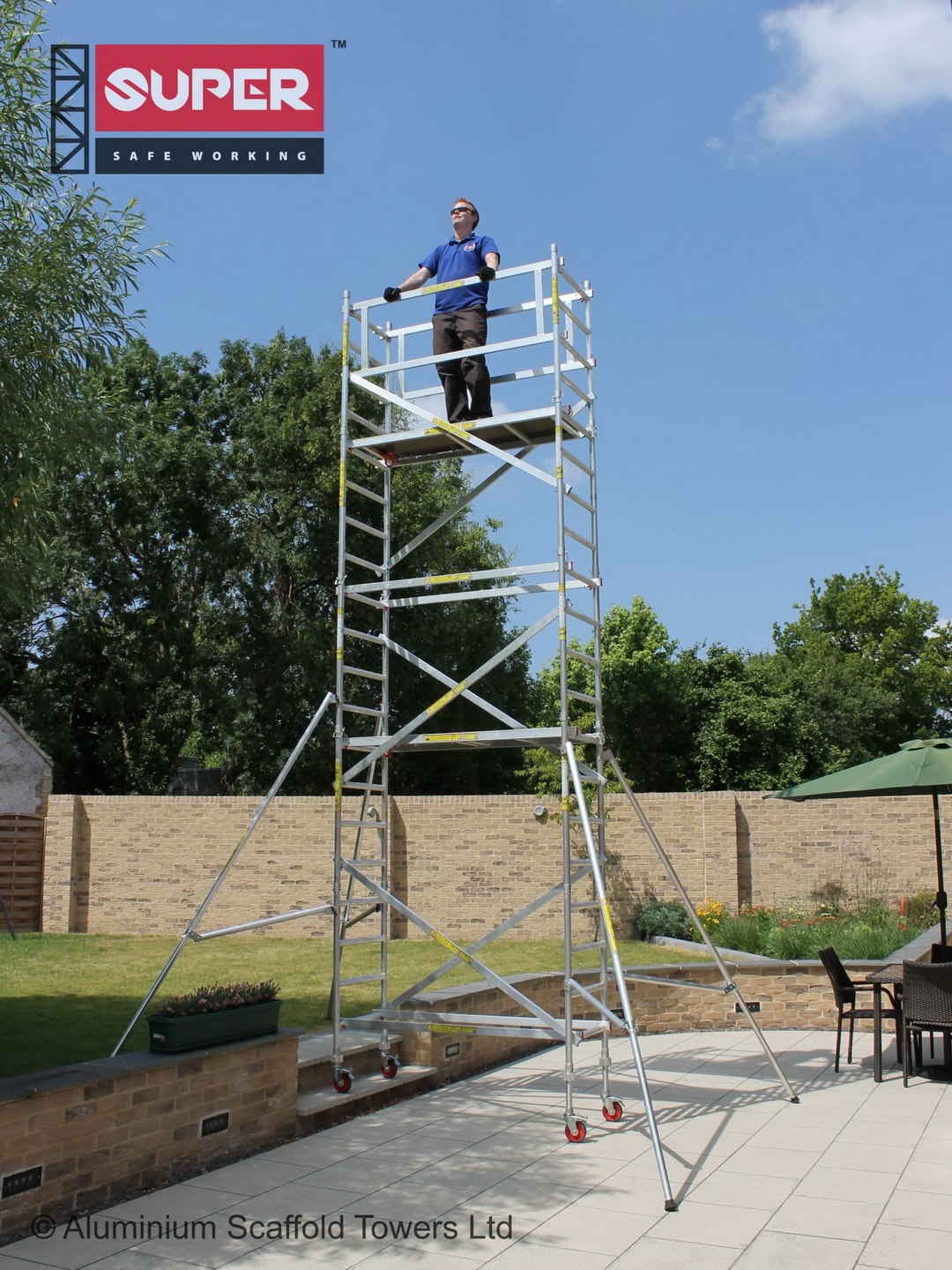
Super DIY Adv+ Tower on Uneven Ground
2. Adjustable Legs & Screw Jacks (Most Common Solution)
Adjustable legs are the most widely used method for handling uneven ground.
When to use:
- 📍 Noticeable slopes where the surface is clearly not level but still reasonably firm
- 📍 Situations where there is a visible height difference across the base
- 📍 Solid ground (concrete, paving, tarmac)
How they work: Threaded spindles allow each leg to be raised or lowered independently to achieve a level base.
Best practice:
- ✓ Always use base plates to spread load
- ✓ Check level in both directions using a spirit level
- ✓ Never exceed maximum extension limits
- ✓ Recheck after initial use (ground may settle)
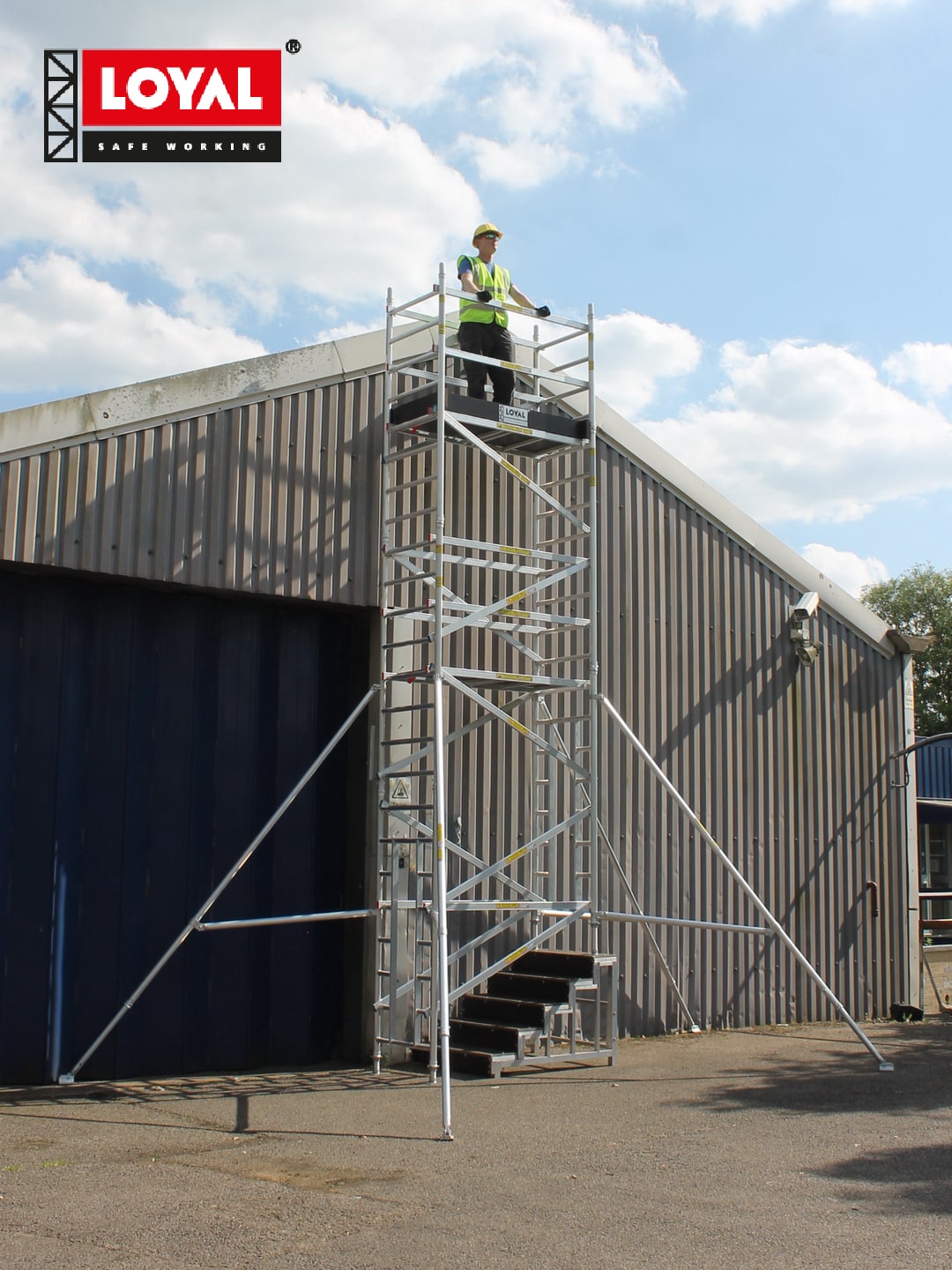
Trade King Stair Tower
3. Outriggers & Stabilisers (Essential for Safety at Height)
Outriggers are non-negotiable when working on uneven ground.
- ⚓ Manufacturer’s Assembly Guide: The old “3:1 ratio” rule is now outdated. To ensure maximum stability and compliance with EN 1004-1:2020, you must follow the manufacturer’s specific assembly guide for the correct outrigger configuration at your required height.
- ⚓ On Slopes: On a slope, the “downhill” outrigger should be extended further to provide a wider base of support.
- ⚓ Strategic Placement: Outriggers must be firmly positioned on a solid surface; if the ground is soft, use sole boards.
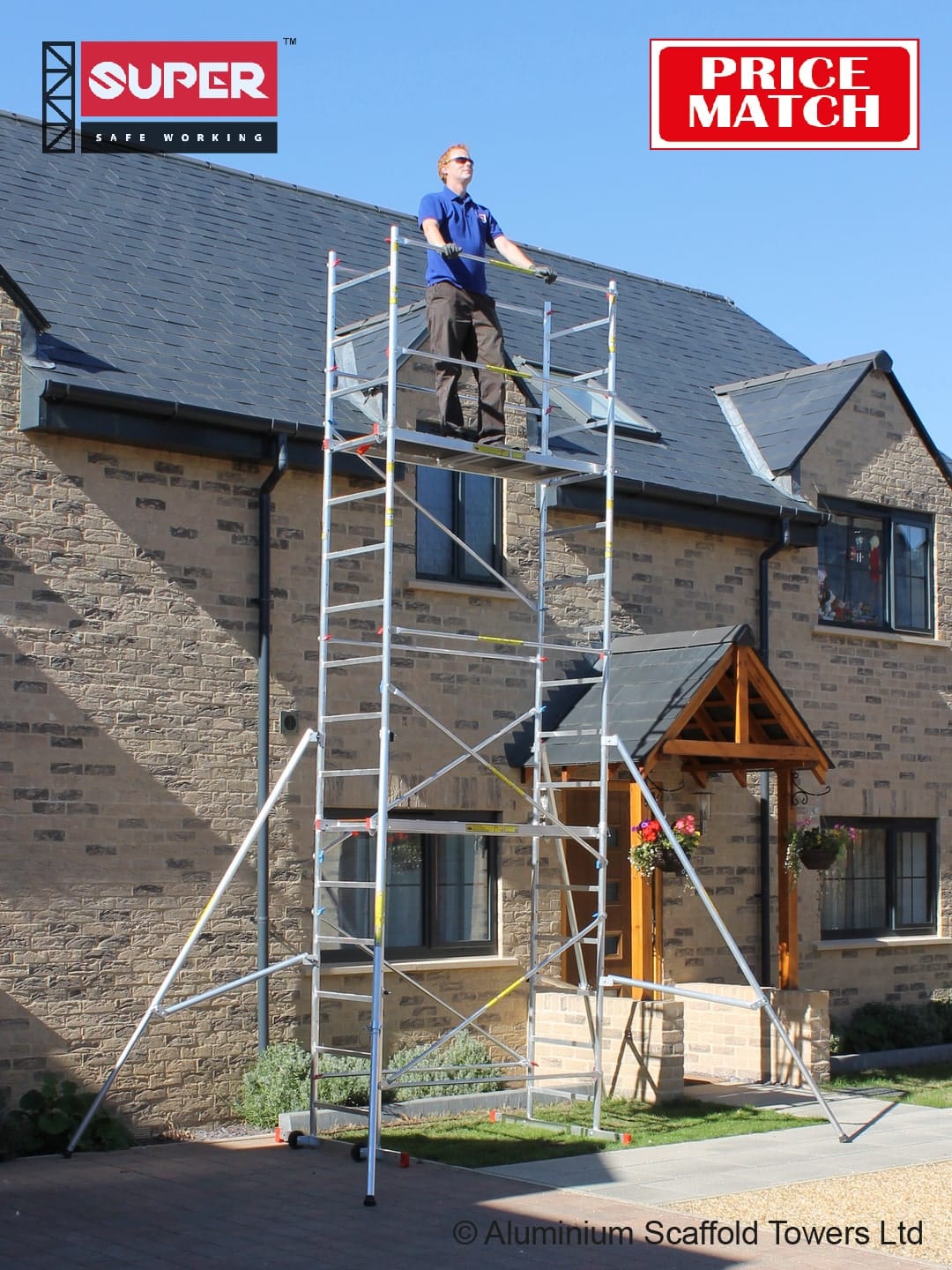
eDIY Tower
4. Ground Preparation (Often Overlooked)
In some cases, the best solution is to improve the ground itself.
Options include:
- ✓ Sole boards → spread load on soft ground
- ✓ Timber pads or plywood sheets
- ✓ Compacted hardcore (MOT Type 1) for long-term setups
When to use:
- 📍 Soft soil or grass
- 📍 Multi-day or ongoing projects
- 📍 Severe uneven terrain

Using Scaffold Towers on Stairs
Standard scaffold towers are not designed for stairs and should not be used in these situations.
👉 The correct solution is a dedicated stair access scaffold tower.
The Most Important Rule: Maintain Walkthrough Access
One of the biggest mistakes is blocking the staircase completely. This creates:
- ⚠️ Safety hazards
- ⚠️ Access problems for occupants
- ⚠️ Potential fire escape issues
A proper stair tower must include:
- ✓ Walkthrough frames (open base design)
- ✓ Narrow width (typically around 730mm)
- ✓ Internal climbing access (3T method)
This allows people to safely walk through the tower while work is carried out above.

Key Features of Stair Access Towers
When selecting a tower for stair use, look for:
- ✓ Adjustable base plates for levelling across steps
- ✓ Compact dimensions to fit UK staircases
- ✓ Internal ladder access for safe climbing
- ✓ Platform height adjustments for different ceiling heights
These features allow safe use even on steep stair pitches commonly found in UK homes.
Step-by-Step Setup on Stairs
- Measure staircase width and pitch
- Position the tower so walkthrough frames align with the stairs
- Adjust base plates to level the structure
- Check alignment using a spirit level
- Build using the 3T (Through The Trapdoor) method
- Tie the tower to a fixed structure if required
⚠️ Always test walkthrough access before use.
Stair Safety Checklist
Before starting work, confirm:
- ✓ You can walk through the tower without obstruction
- ✓ The tower is securely tied (if required)
- ✓ All base plates are firmly positioned
- ✓ Working height is reduced compared to level ground
- ✓ Emergency escape routes are not blocked

Levelling Scaffold Towers on Uneven Ground
There are no fixed UK regulations that define a maximum slope for using a scaffold tower. Instead, the key requirement is that the tower must be assembled level, stable, and in accordance with the manufacturer’s instructions.
For level or nearly level ground, our DIY, Trade King, and Industrial scaffold towers can be assembled using standard base plates or castors.
Where the ground is uneven, the correct solution is to use height-adjustable base plates or adjustable wheels to level the tower before use.
Best Practice for Uneven Ground
- Use height-adjustable base plates or wheels to achieve a level base
- Check the tower is level in both directions before climbing
- Ensure all locking mechanisms are secured
- Use stabilisers / outriggers as required by the assembly guide
- Never use loose bricks, blocks, or timber offcuts for levelling
If the ground cannot be safely levelled using the correct adjustable components, an alternative access solution should be used.
Practical Safety Tips from the Field
Before You Start
- ✓ Carry out a full risk assessment
- ✓ Check weather conditions (wind limit ~17mph / Force 4)
- ✓ Never work alone
During Use
- 🔍 Inspect the base regularly
- 🔍 Watch for movement or settling
- 🔍 Avoid overloading platforms
Stop Work Immediately If:
- 🛑 The tower begins to rock
- 🛑 You hear creaking or stress noises
- 🛑 Components lift off the ground
- 🛑 The structure appears to lean
Choosing the Right Scaffold Tower
Selecting the correct equipment is essential for both safety and efficiency.
Consider:
- ✓ Type of ground (solid vs soft)
- ✓ Severity of slope
- ✓ Working height
- ✓ Indoor vs outdoor use
- ✓ Need for mobility
Typical use cases:
- 🔹 DIY projects on slight slopes: Towers with adjustable wheels
- 🔹 Trade use on uneven ground: Towers with screw jacks and outriggers
- 🔹 Staircases: Dedicated stair access towers

Training & Competence
Working on uneven ground or stairs requires more skill than standard tower use.
Recommended:
- ✓ PASMA training (covers advanced scenarios)
- ✓ Following manufacturer instructions
- ✓ Ensuring all users are competent
For employers, this is not optional—it is a legal requirement under WAHR.
Frequently Asked Questions
Can scaffold towers be used on uneven ground?
Yes, but only with proper levelling equipment such as adjustable legs, wheels, or outriggers. Improvised solutions are unsafe.
What is the maximum slope for a scaffold tower?
There is no fixed maximum slope in UK regulations. The key requirement is that the tower must be level and stable before use.
On uneven ground, use height-adjustable base plates or adjustable wheels to level the tower. If this cannot be achieved safely, the tower should not be used.
Can you use a scaffold tower on stairs?
Only if it is specifically designed for stair use with walkthrough frames and adjustable bases.
Do I need outriggers on uneven ground?
Yes—especially at height or on slopes. They significantly improve stability.
Final Thoughts
Using scaffold towers on uneven ground or stairs is entirely possible—but only when done correctly.
The key principles are simple:
- 🔹 Always level the base properly
- 🔹 Use the correct equipment for the situation
- 🔹 Follow UK safety regulations
- 🔹 Never take shortcuts
If you are unsure about the suitability of your setup, stop and reassess. No job is worth risking serious injury.
