


Blog
Best Scaffold Tower for Exterior Painting: The Complete UK Guide
Every few years, the British weather wins. Paint flakes from the render, the fascias start to look tired, and that once-crisp front elevation has taken on the dishevelled look of a property in need of some serious attention. A fresh coat of exterior paint is not just a cosmetic fix — it is a layer of genuine protection against wind, rain, and frost.
The trouble is, exterior painting is one of those jobs that looks deceptively manageable from ground level and reveals its true complexity the moment you are up a ladder with a brush in one hand and a paint tray dangling from the other. Balancing on a rung while trying to cut in neatly around a soffit is uncomfortable, inefficient, and — when the wind picks up — genuinely dangerous.
The right scaffold tower changes everything. At Aluminium Scaffold Towers, one of the UK’s top online sellers of scaffold towers and ladders — available via our website and eBay — we supply a wide range of aluminium towers suited to every type of exterior painting project. From the Domestic DIY range for homeowners to the Trade King for professional decorators and our Industrial towers for large-scale commercial work, this guide will help you choose the right tower for the job.

Why a Scaffold Tower Beats a Ladder for Exterior Painting
Ladders still have their place — a quick inspection of the guttering or tightening a loose bracket. But for any painting task that lasts more than a few minutes, their limitations become apparent quickly.
- 🔹 Stability and Two-Handed Work: A scaffold tower has a wide, four-legged footprint and a rigid frame. Unlike ladders, these towers provide a flat, wide platform that allows for two-handed work and superior side-to-side reach.
- 🔹 Working space: Exterior painting requires tools — brushes, rollers, trays, masking tape, scrapers, and filler. A scaffold platform gives you a flat, secure surface to keep everything at waist height. A ladder rung gives you nothing.
- 🔹 Reduced fatigue: Standing on a narrow ladder rung for hours creates foot arch pain and leg fatigue that accumulates over a full day’s work. A tower platform lets you move your feet, shift your weight, and work in a natural posture — producing a better finish with less effort.
- 🔹 Efficiency and reach: From a single tower position you can paint a far greater surface area than from a ladder, reducing the number of repositions and giving you a more consistent, uninterrupted finish.
- 🔹 Safety at height: Guardrails, toe boards, and a secure platform mean that even at significant heights, you have three-dimensional protection that no ladder can replicate.

Understanding Height: The Most Important Thing to Get Right
The single most common mistake when buying a scaffold tower is confusing platform height with working height. Choose a tower based on the wrong measurement and you may find yourself unable to reach the top of your property — or worse, overreaching dangerously from a platform that is too low.
There are three measurements you need to understand:
- 📏 Platform height: The height at which your feet will be standing.
- 📏 Working height: Generally calculated as 2.0 metres above the platform height — the comfortable reach of an average person standing with arms raised.
- 📏 Overall tower height: The total structural height including the guardrails above the platform.
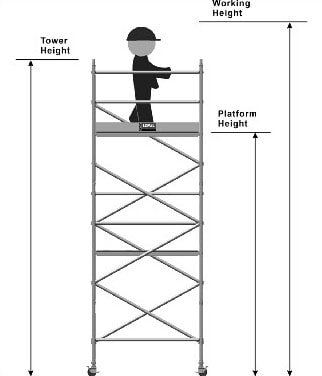
As a practical reference: a standard UK two-storey house typically has eaves at around 4.5m to 5.5m. A tower with a platform height of approximately 3.2m gives a working height of around 5.2m — which is usually the right choice for painting fascias, soffits, and upper-storey walls on a typical semi-detached or terraced home.
For a clear breakdown of platform height, working height, and overall tower height across our full range, see our dedicated Height Specification Guide. Always consult this before purchasing — getting the height right is the foundation of a safe and effective setup.
Choosing the Right Tower: Our Range Explained
1. Domestic DIY Towers — Best for Homeowners
Ideal for painting walls, window frames, and soffits, our DIY range is rust-proof, lightweight, and fits through narrow garden gates.
- ⏱️ Speed: One-person assembly in just 5 to 15 minutes.
- 📦 Storage: Compact enough for a garage; even the 7m Super DIY model fits into a hatchback boot.
- 🛠️ Versatility: Adjustable base plates or wheels ensure the tower stays perfectly level on garden paths or lawns.
- 🪜 Levels: Choose from eDIY (Light Duty) or Super DIY (Heavy Duty).
- 🏠 Best for: A cost-effective solution for homeowners tackling DIY exterior decorating projects.
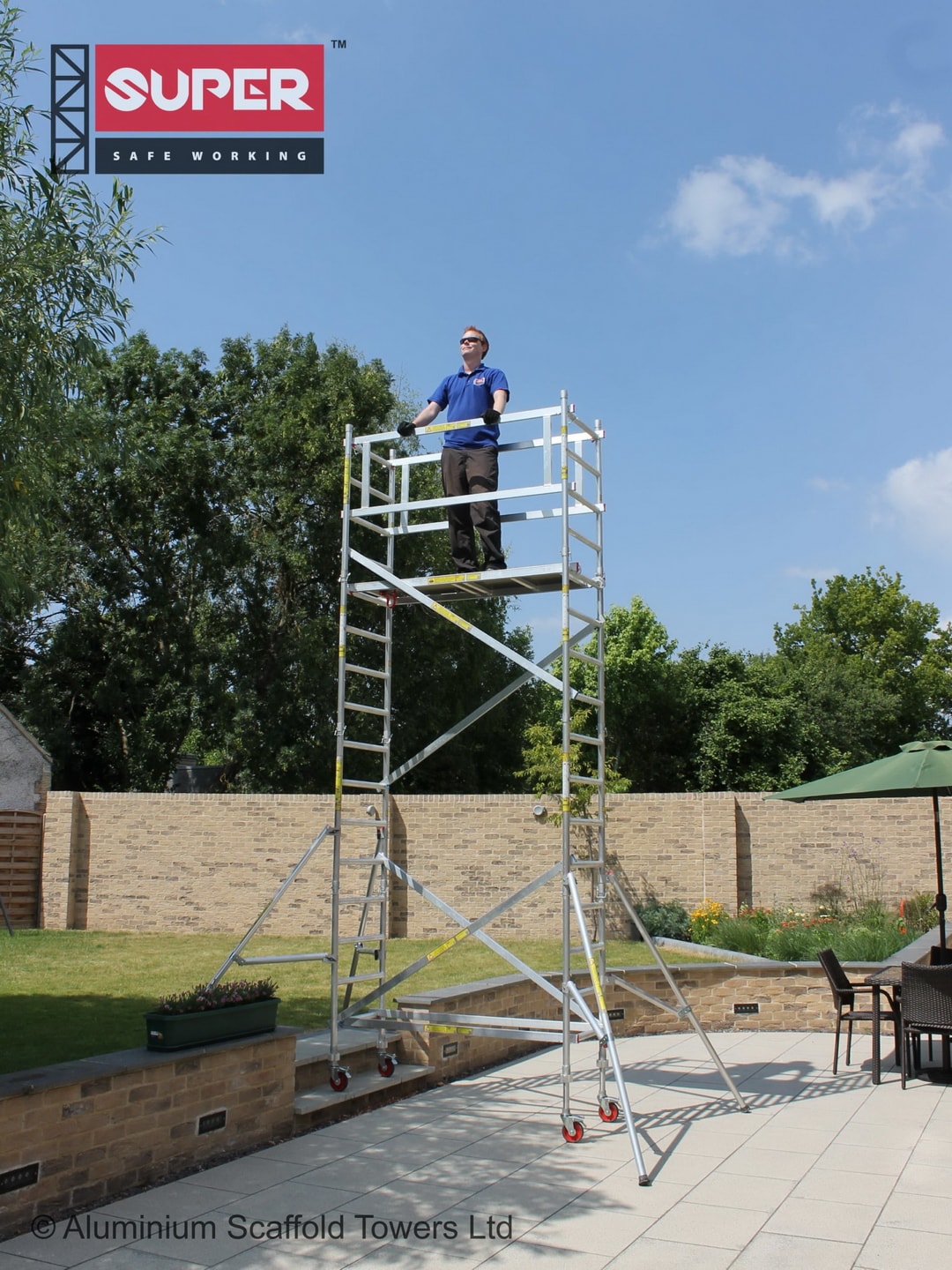
2. Trade King Towers — Best for Professional Decorators and Serious DIYers
Our bestseller, the Trade King, bridges the gap between portability and industrial strength. The rigid frame construction provides a wobble-free platform for detailed masonry and trim work.
- ⚓ Stability: Telescopic outriggers and larger diameter tubing offer superior rigidity and confidence at height.
- 🛡️ Safety: Fully EN 1004 TÜV certified for professional painting and decorating contracts.
- 🏢 Best for: Painting gable ends and three-story facades safely where extended reach is required.

3. Industrial Towers — Best for Commercial and Large-Scale Projects
The gold standard for contractors and large-scale sites, these towers are built for continuous, heavy-duty use and multi-worker platforms. They provide the ultimate stability for professional-quality results on complex facades.
- ✅ Certified Safety: Fully EN 1004 TÜV certified for professional painting and decorating contracts. Uses 3T or AGR systems to eliminate fall risk during assembly.
- 🏗️ Build: Features thick-walled tubing, dual-braked castors, and a high load capacity for heavy equipment and multi-worker use.
- 🏙️ Best for: Reaching facades and gables on apartment blocks, townhouses, and industrial units with total confidence.

As a general rule, it is always better to choose a slightly more capable tower than the absolute minimum for your project. The cost difference between ranges is modest compared to the value of working with greater confidence, stability, and safety margin.
Key Features to Look For
Whatever range you choose, these are the features that have the greatest impact on safety and performance for exterior painting:
- 🔹 Adjustable legs: Properties are rarely built on perfectly level ground. Sloping driveways, gravel paths, and uneven paving are the reality of exterior work. Adjustable legs allow you to level the platform precisely — never try to compensate with loose bricks or timber.
- 🔹 Stabilisers and outriggers: For exterior painting, especially on the side of a building where wind tunnelling can occur, stabilisers are not optional — they are essential. They extend the tower’s footprint and dramatically increase resistance to lateral movement.
- 🔹 Trapdoor platform: Always choose a tower where you climb through the inside of the structure via a trapdoor hatch, rather than scaling the outside. This keeps your centre of gravity within the tower’s footprint at all times and is significantly safer.
- 🔹 Guardrails and toe boards: Guardrails provide fall protection on all sides. Toe boards prevent tools, brushes, and paint kettles from being knocked off the platform edge — important both for your safety and for anyone below.
- 🔹 Narrow vs wide platforms: For most exterior painting jobs on open ground, a wide platform is preferable — more room for tools and a more stable feel. A narrow tower is the right choice where access is restricted, such as a side passage between terraced houses.
- 🔹 Non-slip platform surface: Paint spills are inevitable outdoors. Ensure the working deck has a genuinely non-slip surface that provides grip even when wet.
Getting the Best Results: Setup and Painting Tips
Even the best tower only performs well when set up correctly and used thoughtfully. Here are the practical habits that make the biggest difference:
- ✅ Work from top to bottom: Always begin at the highest point — the chimney stack, the ridge board, or the eaves — and work downward. Any drips or runs will fall onto surfaces you have not yet painted, rather than spoiling work already done.
- ✅ Check level every time you move: Each time you reposition the tower, verify with a spirit level that the platform is horizontal. A slight lean that seems minor at ground level becomes significant at height.
- ✅ Lock the brakes before climbing: An obvious rule, but one that is skipped in the rush to get back up. Every castor must be braked before you step onto the platform.
- ✅ Secure your paint kettle: A small bungee cord looped around the tower frame and through the kettle handle prevents accidental spills and keeps both hands free for the brush.
- ✅ Respect the weather: Avoid painting in direct hot sunlight — the paint dries too quickly and streaks. More importantly, if the wind picks up significantly, climb down. Aluminium towers are light; they are not designed to be occupied in gusty conditions.
- ✅ Never overreach: The most common cause of falls from scaffold towers is reaching beyond the platform edge rather than taking the time to move the tower. If the area you need to paint is not comfortably within arm’s reach, reposition.
Common Mistakes to Avoid
Even experienced users can fall into these traps when setting up for exterior painting:
- ❌ Choosing a tower that is too short for the property — always calculate working height, not platform height
- ❌ Skipping stabilisers/outriggers to save setup time — on uneven outdoor ground, this is a serious safety risk
- ❌ Using loose bricks or timber to level a tower leg — always use the built-in adjustable legs
- ❌ Overloading the platform with too many heavy items — always check the rated load capacity
- ❌ Moving the tower while someone is still on it — always climb down first
- ❌ Assembling or working on the tower in high winds — if in doubt, come down
Frequently Asked Questions
What height scaffold tower do I need for exterior painting?
Choose based on your “Working Height” (Platform Height + 2m). For a standard UK two-storey house with eaves at 4.5m–5.5m, a 3.2m platform height (5.2m working height) is usually ideal. See Height Specification Guide.
Can I use a scaffold tower on uneven ground?
Yes, provided you use the right gear. Use height adjustable baseplates / wheels to level the unit on slopes or uneven paving. Never use bricks or timber to pack out the base; use stabilisers/outriggers to maximise the tower’s footprint.
What does EN 1004 TÜV certified actually mean?
TÜV is an independent global testing body. Certification confirms the tower has passed rigorous structural tests and will not buckle or tip under specified loads. Both our Trade King and Industrial ranges are TÜV certified, ensuring they meet strict European safety standards for professional and commercial use.
Do I need a licence or PASMA certificate to use a scaffold tower?
For domestic DIY projects, no licence or certificate is legally required; you simply need to follow the assembly instructions. However, on many commercial construction sites, site managers require a PASMA qualification as proof of competency, even though it is not a legal requirement.
Is an aluminium scaffold tower better than a steel one for exterior work?
Absolutely. Aluminium is roughly one-third the weight of steel, making it easier to assemble and move alone. Crucially, aluminium does not rust. Unlike steel, which corrodes in damp UK garages, an aluminium tower is a rust-proof, long-term investment perfectly suited to the British climate.
The Verdict: Invest in the Right Tower and the Job Takes Care of Itself
Exterior painting is one of the most rewarding home improvement tasks you can undertake — a job that transforms the look of a property and protects your biggest asset from the British elements. But it deserves the right equipment. A scaffold tower does not just make the job safer; it makes it faster, more comfortable, and produces a genuinely better result than anything achievable from a ladder.
Whether you need a compact eDIY tower for a weekend refresh of a terraced house, a Trade King for a professional decorator tackling properties across multiple sites, or an Industrial tower for a commercial building project, the right solution is in our range. Browse the full range at aluminium-scaffoldtowers.co.uk or visit our eBay store to see our latest availability and pricing.
If you are unsure which tower suits your project, our team is always happy to advise — work higher, work safer, and get the finish your property deserves.
