



Blog
Base Plates, Castors, or Base Bars? Choosing the Right Foundation for Your Scaffold Tower
When erecting a scaffold tower, most people focus on platform height, guardrails and frame size. However, the true safety of the structure starts at the very bottom. The “feet” of the tower — whether base plates, wheels (castors), or base bars— are its most critical safety features.
Choosing the right foundation isn’t merely a matter of preference; it is strictly determined by your work environment, ground conditions, and the mobility requirements of your project. While base plates and wheels provide specialised levelling options for uneven surfaces, the three types serve distinct purposes: one is about fixed stability, one about mobile efficiency, and the third about enhanced tip-resistance for domestic use.
This guide breaks down the differences so you can make the safest and most practical choice for your project.
1. Base Plates — The Bedrock of Stability
Base plates are flat steel or aluminium plates that sit under each leg of a scaffold tower. They are the standard choice when a tower needs to remain in one position for the duration of a job.
Purpose & Design
Base plates are engineered to spread the weight of the tower over a larger area than a bare tube. By increasing the footprint of each leg, they provide a strong, secure foundation for stationary tasks on firm surfaces.
Most modern base plates can be used with height-adjustable screw jacks, allowing you to level the tower accurately on uneven terrain.
⚠️ SAFETY NOTE: UK guidance under the Work at Height Regulations 2005 and HSE/PASMA guidance requires scaffold towers to be erected on firm, level ground. Where the ground is soft or uneven, sole boards (or base plates with sole boards) should be used to spread the load and prevent settlement or instability. This must be done with extreme care, following all safety guidelines.

Base Plates with Sole Boards
Typical Use Cases
- 📍 Stationary projects where the tower will not be moved
- 🏠 Outdoor work on firm gravel or uneven hard-standing
- 🧱 Brickwork, rendering, cladding and roofing
- 🔧️ Long-term maintenance jobs
Key Advantages
- ✓ Maximum stability — lowest safety risk when used on correct surfaces
- ✓ Improved load distribution compared to bare legs
- ✓ Height adjustable when paired with screw jacks
- ✓ Robust and simple — no moving parts
- ✓ Ideal for heavier-duty work

Base Plates for Scaffold Towers
2. Wheels (Castors) — Mobility and Efficiency
Wheels, or castors, attach to the tower legs to transform a static structure into a mobile unit. For maximum safety, you must use high-quality castors with reliable heavy-duty swivel and braking mechanisms. It is critical that all wheels are securely locked before anyone climbs the tower to prevent shifting.
Purpose & Design
The primary goal of castors is mobility. Proper scaffold castors include heavy-duty swivel mechanisms, foot-operated brakes, and often threaded stems for height adjustment. This allows a tower on wheels to be levelled accurately on slightly uneven indoor or hard surfaces.
Typical Use Cases
- 🚀 Painting long walls or ceilings
- ✨ Electrical and lighting installations
- 🏠 Shop fitting and warehouse maintenance
- 🏢 HVAC and M&E work
⚠️ SAFETY WARNING: Castors are not suitable for soft or uneven ground as wheels can sink, slip, or shift dangerously. Per UK HSE and PASMA standards, never move a mobile tower with people or materials onboard. Ensure the tower height is below 4 meters before moving and only push or pull from the base.

Castors (Wheels) for Mobile Towers
3. Base Bars — The Domestic Alternative
Base bars (stabiliser bars) are long horizontal bars that attach to the bottom of the tower frames. For some domestic and DIY towers, these are used as the primary footing instead of individual castors or base plates.
Purpose & Design
Base bars significantly widen the “footprint” of the structure, increasing the tower’s resistance to tipping and providing a stable foundation for home-based projects.
⚠️ Note: Unlike adjustable base plates or wheels, base bars do not typically offer height adjustment and must be used on flat, firm, and level ground.
Typical Use Cases
- 🏠 Domestic and DIY projects
- 🧱 Indoor and outdoor work on smooth, hard surfaces
- ⏱ Situations where the tower needs to be moved infrequently
- 🏢 Use with specific systems like the Loyal SUPER DIY tower
Key Advantages
- ✓ Enhanced safety — wider footprint provides better stability against tipping
- ✓ Simple setup — ideal for projects on level surfaces
- ✓ Hybrid mobility — some feature “tilt and glide” wheels for occasional movement
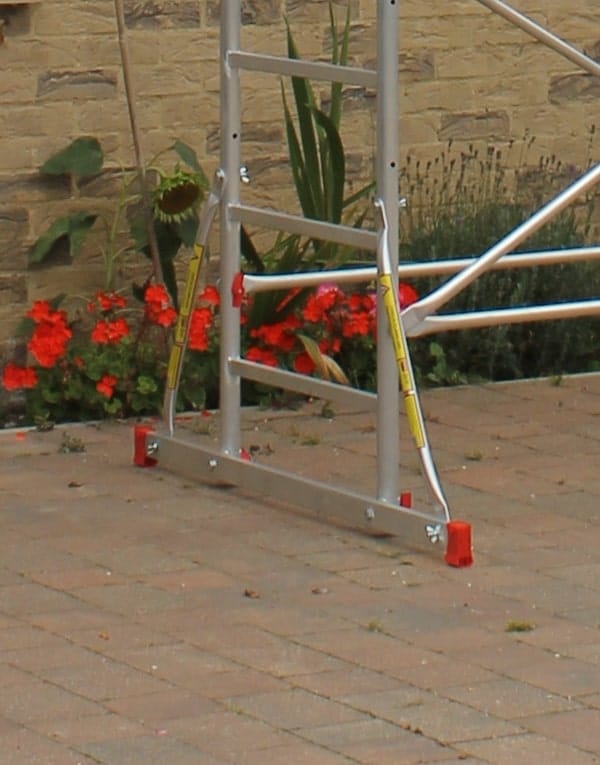
Base bars
4. Height Adjustment — Important Distinction
A common myth is that all footing types allow levelling. In reality:
- ✔ Base plates can be height-adjustable.
- ✔ Castors can be height-adjustable.
- ✖ Base Bars generally do not offer height adjustment and require level ground.

Close-up of height-adjustable scaffold wheels
5. Comparison at a Glance
The following table compares the three primary footing options for scaffold towers:
| Feature | Base Plates | Wheels / Castors | Base Bars |
|---|---|---|---|
| Mobility | ❌ Stationary | ✔️ Mobile | ⚠️ Limited (Tilt & Glide) |
| Best Surface | Firm / Uneven / Outdoor | Flat, Smooth | Firm, Level Ground |
| Use Case | Long-term fixed work | Frequent repositioning | Domestic / Infrequent movement |
| Height Adjustment | Yes | Yes | System dependent |
6. Safety & Regulations
Whether you use base plates or wheels, compliance with safety standards (such as UK HSE guidance) is essential.
Key Rules
- 🏗️ Load Distribution: Base plates with sole boards are usually required when working on soil or surfaces that won’t support the concentrated load of a wheel.
- 🛑 The Brake Rule: With wheels, all castors must be locked before anyone climbs the tower.
- 🚫 Never move a tower while someone is on it.
- 📐 Level and Plumb: Both systems must be adjusted so the tower is perfectly vertical.
- 🔍 Inspections: A competent person should inspect the tower after assembly and regularly during use.
Most scaffold tower accidents involving wheels happen because brakes weren’t applied or the surface wasn’t suitable.
7. Which Should You Choose?
Choose Base Plates if:
- ✅ The job is stationary and on firm/level ground.
- ✅ Heavy-duty tasks are involved.
- ✅ Maximum stability is the priority.
Towers with base plates:

Trade King Stair Tower
Choose Wheels (Castors) if:
- ✅ You need to move the tower often on smooth, hard surfaces.
- ✅ Speed and efficiency matter.
Towers with wheels:

SDIY Advanced Plus Tower
Choose Base Bars if:
- ✅ You are working on flat, level domestic ground.
- ✅ Maximum tip-resistance is required for DIY tasks.
Towers with base bars:

eDIY Towers with Toeboard
🔧 Final Thoughts
- 🔹 Base plates = fixed strength and stability on firm or levelled ground.
- 🔹 Castors = adjustable mobility and efficiency on smooth surfaces.
- 🔹 Base Bars = enhanced stability and tip-resistance on flat, level ground.
The right choice depends entirely on the environment. For varied terrain, base plates with sole boards are essential. For finished floors and fast-moving jobs, castor wheels are your best friend.
